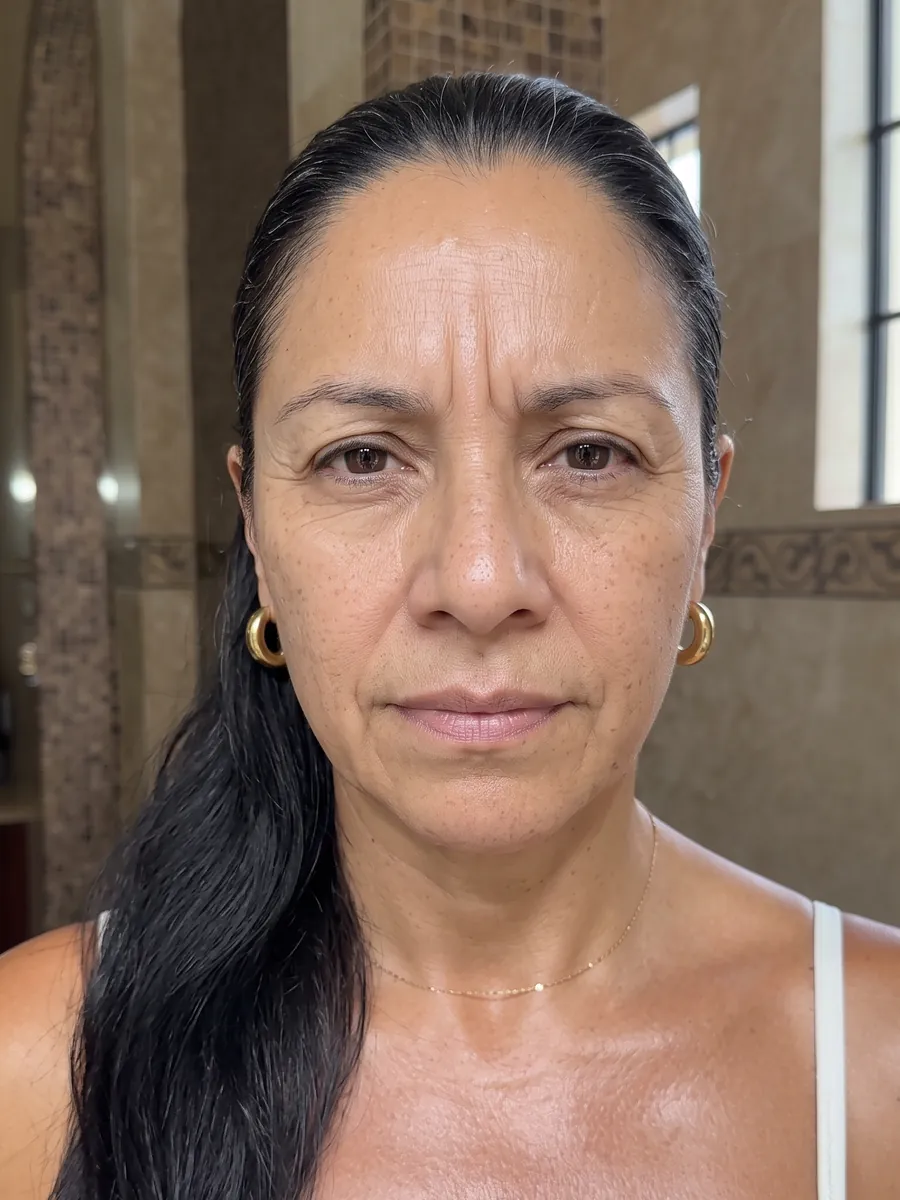
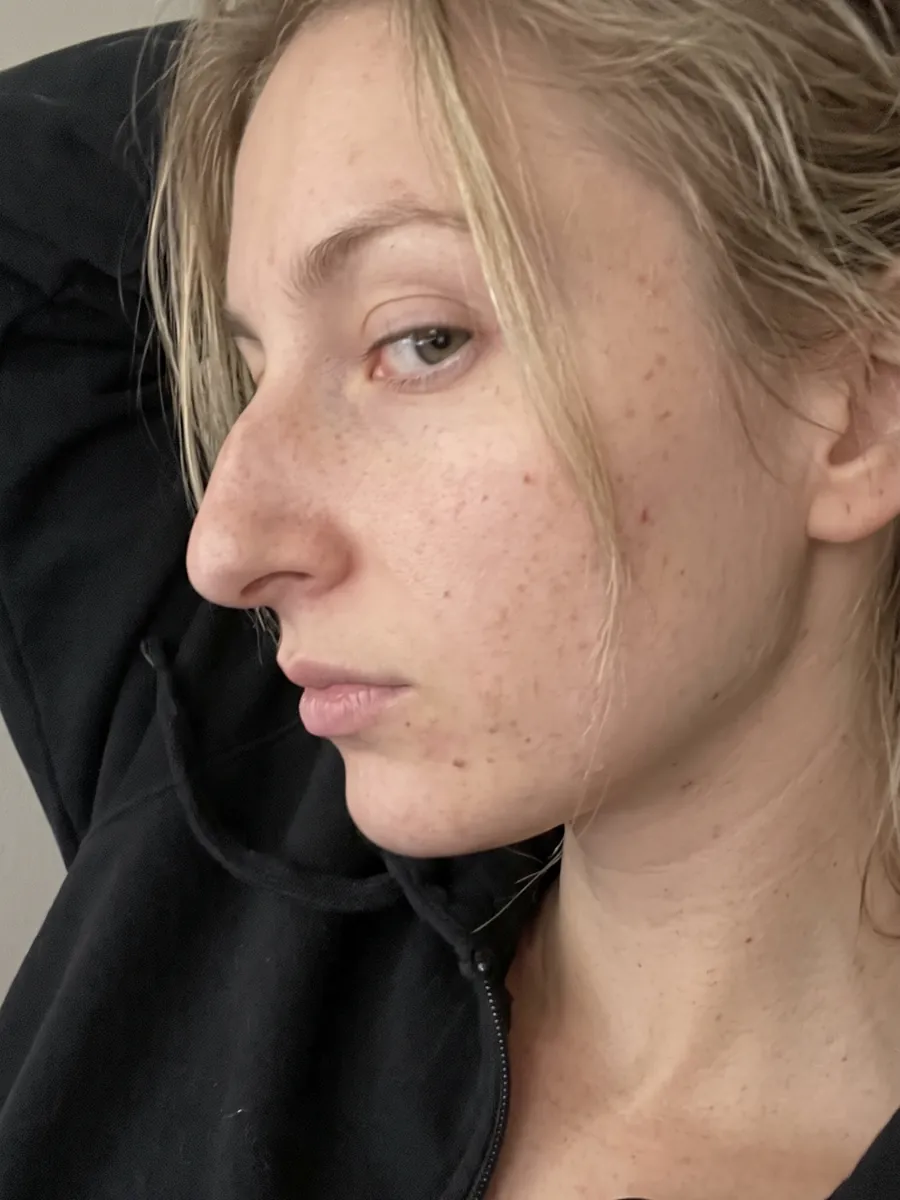
What you'd look like with lip filler, on your own face
By Jérémie Aouate, founder of Mevona. Updated October 22, 2026.
Lip augmentation adds volume and definition to your lips. On this page it means hyaluronic acid filler unless said otherwise. The page shows what that looks like on a whole face, at three doses, from the front and in profile, with an indicative volume in milliliters for each, and how to see the same thing on your own photos. What you see here is a Cosmetic Preview, an illustration of the kind of change, not a predicted result.


In short
- Lip augmentation adds volume to the lips and definition to their outline. Cleveland Clinic describes most lip fillers as synthetic hyaluronic acid, which a provider can dissolve with an enzyme called hyaluronidase.
- In 2025, hyaluronic acid fillers made up 30 percent of the minimally invasive procedures reported by ASPS member surgeons, and lip augmentation accounted for 23 percent of that filler work.
- It wears off. Cleveland Clinic gives six months to a year on one page and 12 to 18 months on another, and in a 2021 meta-analysis 46 percent of people were still rated fuller at 12 months.
- The ASPS lists an average cost of $743 for lip augmentation with dermal fillers. Health insurance does not cover it.
- This page shows lip filler at three doses on one face, front and profile, each with an indicative volume of 0.5 ml, 1 ml or 2 ml, and what the Facial Dossier reads on the lips first.
What lip augmentation changes
Your mouth has three parts that matter here. The red part of the lips, the vermilion, is soft tissue over a ring of muscle. Its edge, the vermilion border, draws the outline, with the Cupid's bow at the center of the upper lip. Above it sits the philtrum, the skin between the base of your nose and your upper lip. Filler works on the first two, and the preview shows it that way: volume in the body of the lip, definition along the border. Cleveland Clinic describes lip fillers as a way to add volume to the lips, usually with hyaluronic acid, a substance your body already makes.
What moves in the preview: the height of red lip you see from the front, how far the lips sit forward in profile, and how clearly the border reads. What does not move: the width of your mouth, your teeth, the length of the philtrum, your nose, your chin and your expression. Everything else stays. A long upper lip stays long after filler. Shortening it is what a lip lift does, by surgery, and the two are easy to confuse in a photo.
A before and after that changes the light, the angle, the lip color or the camera distance between two photos shows more than the filler. A fair comparison keeps all of those identical, which is what a preview on a single photo does by construction. The swelling of the first days also flatters an after photo taken too early.
In the Facial Dossier, the lips have their own section, number 6 of 17. On your front photo it measures mouth width in millimeters and the mouth width-to-face ratio, and it reads the length of your philtrum as a trait. The section ends with one of three verdicts: keep, change, or discuss. That reading comes before any preview, so you know what you are starting from.
Where you'd stop: subtle, moderate, full
Mevona shows every procedure at three doses on the same photo. They are not filler plans. They are three distances along the same direction, so you can see where you would want to stop. The names below are the ones you will see in the app.
Subtle: a little more definition
The outline of both lips reads crisper and the Cupid's bow is a little more defined. Volume barely changes, so the mouth keeps its proportions from the front and in profile. This is the dose to look at when you want to know whether definition alone is what you were picturing.
Moderate: fuller lips
Both lips gain visible height from the front, and in profile they sit slightly further forward. The balance between the upper and the lower lip is kept, so the mouth reads fuller rather than different. This is the dose where the change starts to show in every photo and the face still reads as the same person.
Full: full volume
The lips are at the largest volume the preview shows in one pass, with clear projection in profile. From the front, the red of both lips takes up more of the lower face and the outline is at its most defined. It is the dose to look at against the rest of your profile, especially the nose and the chin, to see whether that much volume fits.
Injectors do not work in doses. They work in milliliters, and the amount depends on your lips. As an indicative correspondence only, subtle sits near 0.5 ml, moderate near 1 ml and full near 2 ml. Cleveland Clinic puts the average amount placed in the lips at about 1 ml, roughly a fifth of a teaspoon. A 2026 systematic review of 16 studies found that most protocols used 1 to 2 ml per session, and a 2025 prospective study placed 0.5 ml in each lip in a single session. The same volume looks different on thin and on full lips, which is why this correspondence is indicative and never a plan.
The three doses are a way of looking, not a menu. What suits your lips, and over how many sessions, is a conversation to have with a qualified professional. If you are weighing half a milliliter against one, 0.5 ml vs 1 ml looks at that difference on the same face.
Front and profile
Lip filler is usually judged from the front, and that is the main visual on this page. The front view shows the height of red lip, the outline and the balance between the upper and the lower lip. The profile shows something the front cannot: projection, how far the lips sit forward of a line drawn from the tip of the nose to the chin. Two mouths can show the same height of lip from the front and very different projection in profile.
That is why Mevona asks for three photos, one from the front and one from each side. Look at the front first for the outline and the balance between the two lips, then at the profile to check that the projection still suits your nose and your chin. On one face, the full dose can read larger in profile than it does from the front, and that difference is worth seeing before anything is placed.
Techniques and variants
Lip augmentation covers several approaches. The main ones:
- Hyaluronic acid filler. The default meaning on this page. Filler is placed in the body of the lip, along the border, or both. A 2026 systematic review compared linear, retrograde and microdeposit approaches across 16 studies and found that the evidence does not favor a single technique, instrument or product.
- Half a milliliter or one. The volume question has its own page: 0.5 ml vs 1 ml.
- Fat grafting. Fat is taken from another area, often the stomach, purified and placed in the lips. Cleveland Clinic says it lasts at least five years, and the AAFPRS notes that the fat that remains after the body absorbs part of it is typically permanent.
- Surgical lip augmentation. A lip implant placed through small incisions at the corners of the mouth, or a dermal graft placed under the lining of the lip. The AAFPRS describes both as permanent options. Cleveland Clinic adds that implants can be removed at any time.
- Lip lift. Surgery that shortens the distance between the nose and the upper lip rather than adding volume. See lip lift.
- Lip flip. A different approach to the upper lip, compared with filler and the lift on the same face in lip flip vs lip filler vs lip lift.
Who usually considers it
People come to lip filler from a few starting points, which the AAFPRS lists: thin lips that disappear when they smile, lips that have lost fullness with age, or lips that feel out of balance with the rest of the face. Others want to see what a little more definition would look like before they book anything at all. It is a common request: lip augmentation accounted for 23 percent of the hyaluronic acid filler work reported by ASPS member surgeons in 2025. Cleveland Clinic notes that the FDA has not approved lip fillers for anyone under 21.
None of that says whether filler is right for your lips. That is not something a page or a preview can tell you. What a preview can do is show you the direction and the distance, so that when you discuss it with a qualified professional, you already know which dose you were picturing and whether it was volume or the length of the upper lip you were looking at. The concern page on thin lips goes deeper on that starting point, and the lip lift page covers the other one.
Lip augmentation vs lip lift
| Lip filler | Lip lift | |
|---|---|---|
| What it is | Hyaluronic acid filler placed in and along the lips | Surgery: a strip of skin removed under the nose, the upper lip lifted |
| What it can do | Add volume and definition to both lips, according to Cleveland Clinic | Shorten the distance between the nose and the upper lip, according to the AAFPRS |
| What it cannot do | Shorten a long upper lip | Add volume to the lower lip |
| How long it lasts | Six months to a year, or 12 to 18 months, depending on the Cleveland Clinic page | Permanent, according to Cleveland Clinic |
| Recovery | Little to no recovery time | Bruising, redness and swelling for a few days to several weeks |
| Reversibility | Hyaluronic acid filler can be dissolved with hyaluronidase | Not reversible |
| Risks named by the source | Bruising, swelling, lumps, asymmetry, skin necrosis, rare vascular occlusion (ASPS) | Scarring, infection, lip stiffening, uneven lips (Cleveland Clinic) |

The two answer different questions: filler changes how much lip there is, the lift changes where the upper lip sits. The side by side on the same face is on lip lift vs lip filler, and the lip flip joins them in lip flip vs lip filler vs lip lift.
Cost, recovery, risks
Cost
| Typical range | $743 to $743 |
|---|---|
| Source | ASPS average cost of lip augmentation with dermal fillers, no range published; health insurance does not cover dermal fillers |
Indicative. A quote depends on the technique, the city and the practice.
The ASPS lists an average cost of $743 for lip augmentation with dermal fillers and does not publish a range. Its page does not say how many milliliters that figure covers. Health insurance does not cover dermal fillers, according to the ASPS. Because hyaluronic acid filler wears off over months, it is a cost that comes back with each session rather than one paid once.
Recovery
- Day 0A visit of 30 minutes to two hours, usually after a numbing cream. Cleveland Clinic puts the average amount placed in the lips at about 1 ml.
- Day 1 to 2Mild pain eases within 12 to 24 hours and swelling usually goes down within 24 to 48 hours, according to Cleveland Clinic.
- Week 1Any remaining swelling settles. Cleveland Clinic notes it can take up to a week.
- Month 2In a 2021 meta-analysis of hyaluronic acid lip filler, 91 percent of people were still rated at least one step fuller than before.
- Month 674 percent were still rated at least one step fuller in the same meta-analysis.
- Month 1246 percent were still rated fuller. Cleveland Clinic gives six months to a year on one page and 12 to 18 months on another.
Two sources frame the timeline. Cleveland Clinic puts the visit at 30 minutes to two hours, mild pain easing within 12 to 24 hours, and swelling going down within 24 to 48 hours, sometimes up to a week. A 2021 meta-analysis of hyaluronic acid lip filler measured how long the effect holds: 91 percent of people were still rated at least one step fuller at two months, 74 percent at six months and 46 percent at 12 months, with the authors concluding the effect lasts at least six months. Cleveland Clinic gives six months to a year on one page and 12 to 18 months on another, and adds that younger people tend to break filler down faster.
Risks
The ASPS lists the known risks of dermal fillers: acne-like eruptions, asymmetry, bleeding, bruising, damage to the skin that can leave a scar, infection, lumps, filler you can feel under the skin, skin necrosis, a rash with itching, redness, swelling, and under- or over-correction. In very rare cases, it says, filler enters a blood vessel and blocks blood flow, which can lead to skin loss or, if the eye is affected, loss of sight. Cleveland Clinic names the same event for lips, tissue death from vascular compromise, and adds cold sore reactivation and filler migrating toward the nose.
Vascular occlusion has a measured scale. In a 2021 study of 370 dermatologists covering about 1.7 million ml of filler, occlusion happened about once per 6,410 ml placed with a sharp tip and once per 40,882 ml placed with a blunt cannula, and the lips and the folds beside the nose were the sites most often involved. Most events were minor. In the 2021 meta-analysis, tenderness (88.8 percent), swelling (74.3 percent) and bruising (39.5 percent) were common and short-lived, while granulomas and cold sores each affected 0.6 percent of people. Your own risk depends on your anatomy, your health and who places the filler, and belongs in a consultation with a qualified professional. Cosmetic Previews are illustrative and do not predict the result of any procedure.
Often combined with
Two combinations come up often enough that Mevona previews them on the same photo:
- Lip lift. Filler adds volume while a lip lift shortens the space above the upper lip, so seeing both on one face shows which of the two your mouth was asking for. See lip lift.
- Chin augmentation. In profile the lips are read between the nose and the chin, and a little more chin projection changes how far forward the same lips appear. See chin augmentation.
The combination previews use the moderate dose of each procedure, from the front.
Send three photos from your phone, front and both sides, in your own light. Pick lip augmentation and a dose, and see the change on your lips while the rest of your face stays as it is. Go from a little more definition to full volume, switch to profile to check the projection, and compare with a lip lift on the same photo. Your Facial Dossier follows within 24 hours, with the lips section measured and read, and the previews are there while you wait. One membership, $99 a year, all 29 procedures. Take your time, then decide.